
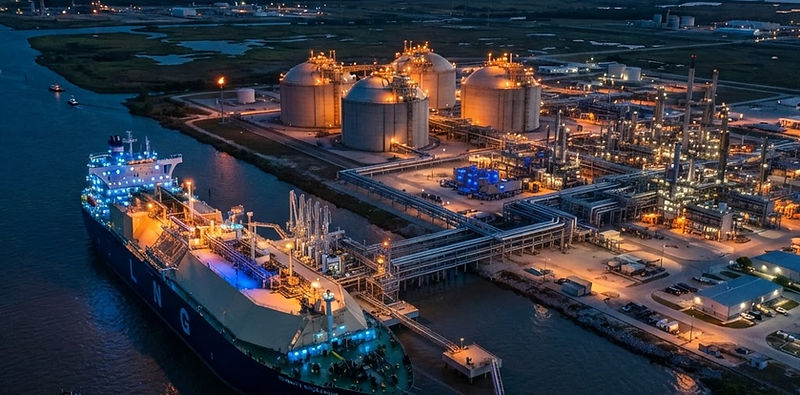
With new Gulf Coast terminals ramping up and Asian buyers signing long-term contracts, American energy is reshaping Pacific fuel markets. The strategic upside is real, but the margin between boom and glut is thin.
U.S. liquefied natural gas exports to Asia reached a record in 2026, with monthly volumes to Japan, South Korea, China, and India collectively exceeding 7 million tonnes for the first time. The expansion of Plaquemines, Corpus Christi Stage 3, and Golden Pass has added roughly 20 billion cubic meters of annual capacity, and Asian buyers have absorbed the majority of the incremental supply.
The strategic significance is considerable. Every additional cargo of American LNG reaching a Pacific ally reduces that ally's exposure to any single supplier and deepens the commercial relationship that underpins the broader security architecture. For Japan and South Korea, which together import more than 60 million tonnes of LNG annually, diversification away from historical dependence is a national security objective as much as an economic one. Long-term U.S. contracts now anchor a meaningful share of their winter baseload.
The economics, however, are more fragile than the headlines. The 2026 Asian LNG market is well supplied, with Australian and Qatari capacity also expanding, and spot prices have softened relative to the 2022 to 2024 peak. New U.S. terminals are coming online into a market that may not need every molecule at the price points that justified the investment. The risk of a mid-cycle glut, concentrated in 2027 to 2028, is real and underappreciated.
A second consideration is the domestic balance. Export demand tightens the U.S. natural gas market, and while 2026 Henry Hub prices remain manageable, the trajectory of power-sector gas demand, driven by data center electrification and coal retirements, points toward a more contested domestic market later in the decade. Policymakers will face the recurring question of how much export capacity is consistent with domestic affordability.
The opportunity for 2026 is to lock in the strategic gains while the market is favorable. Long-term contracts with allied buyers, coordinated infrastructure investment with Japan and Korea, and a clear regulatory pathway for the next wave of terminals would consolidate American LNG as the swing supplier of the Pacific. The danger is overbuilding into a soft market and undermining the very economics that made the boom possible.