
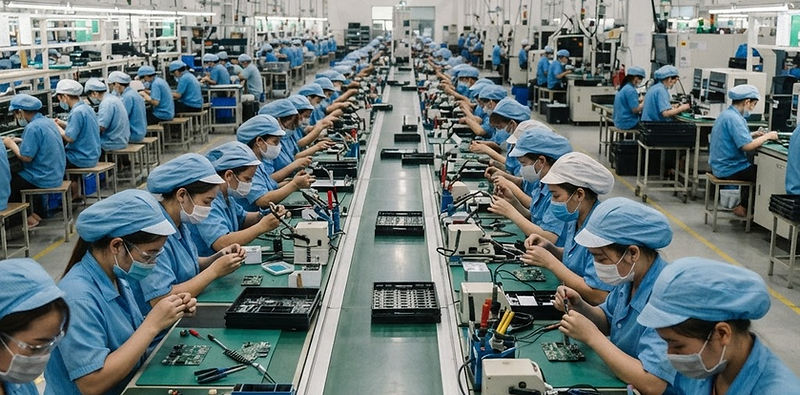
Of all the economies absorbing redirected Pacific trade, Vietnam has pulled ahead decisively. But the boom is testing the country's infrastructure, labor market, and political balancing act in equal measure.
Vietnam's position as the principal beneficiary of the China-Plus-One strategy is no longer a forecast; it is a 2026 fact. Foreign direct investment commitments to Vietnam through the first three quarters of 2026 reached a record $36 billion, with the largest share flowing into electronics assembly, textiles, and increasingly, precision components.
The drivers are familiar: a competitive wage base roughly one-third of China's coastal manufacturing hubs, a network of free trade agreements covering more than 60 economies, and a government that has made export-led industrialization its central organizing project. What is new in 2026 is the scale and sophistication of the investment. Samsung, Apple suppliers, and a growing roster of European industrial firms are no longer treating Vietnam as a final-assembly stop; they are building deeper supplier networks and R&D presence in country.
The constraints, however, are becoming binding. Port throughput at Hai Phong and Cai Mep is approaching capacity, and power reliability in the northern industrial corridors emerged as a serious operational risk through the summer. The labor market is tightening; wage growth in key manufacturing provinces is running above 9 percent annually, and the pool of available rural labor is thinner than the headline numbers suggest. A country of 100 million cannot absorb unlimited relocation without strain.
The geopolitical dimension is the most delicate. Vietnam's strategy has been to maintain workable relations with both Beijing and Washington, a balance that grows harder as the tariff regime forces binary choices. Recent export-control alignment with the United States on advanced technology has drawn measured pushback from China, Vietnam's largest trading partner. Hanoi's bet is that being indispensable to both sides is safer than choosing one; 2026 will test how long that equilibrium holds.
For firms evaluating Vietnam, the takeaway is to invest with eyes open. The opportunity is real and durable, but the era of frictionless expansion is ending. Site selection now requires the same rigor that mature investors apply in China: infrastructure due diligence, workforce planning, and a clear view of how policy in Hanoi, Washington, and Beijing intersect at the factory floor.